Earl of Matlock
Just DesertsThe Earl of Matlock represents the institutional power of the aristocracy: a title, a place in the House of Lords, influence over legislation, and a family structure organized around inheritance and advantageous marriage. He is not developed through an independent life history so much as through the social system he embodies, especially when that system confronts Darcy’s refusal to marry Anne de Bourgh and Elizabeth Bennet’s determination to choose her own future.
Identity and Social Position
The Earl is identified as the current head of his branch of the Matlock family and as the uncle of Fitzwilliam Darcy. Elizabeth Bennet explains that his position matters because he is an Earl with political power, not merely because he possesses the outward glamour associated with rank. He sits in the House of Lords and can vote on laws affecting ordinary people, including legislation governing trade after the defeat of the Corsican tyrant and the reopening of commercial relations with the Continent. His position therefore connects aristocratic privilege to decisions that shape the lives and fortunes of people outside the aristocracy.
Elizabeth reduces the underlying mechanics of his world to a stark formula: society is built from power, money, connections, and advancement. The Earl’s title gives him authority even when he has no direct ties to trade, while legislation he helps determine can affect the commercial interests of Elizabeth Bennet’s relatives. His significance lies in that distance between decision and consequence. He may not participate in trade himself, but his social and legislative position permits him to influence the conditions under which others prosper or fail.
Family Strategy and Marriage Politics
The Earl belongs to a family system in which marriage is treated as an instrument for consolidating status, wealth, and influence. Elizabeth describes the family’s generations as an arrangement in which the eldest son inherits, younger sons enter professions, and daughters marry in order to increase family connections. The Earl’s own family history illustrates the movement up and down this social ladder: a baron’s daughter married a viscount who later became an Earl, making her a Countess, while another daughter married a wealthy baronet. Elizabeth’s mother, by contrast, married an untitled but wealthy man for what appears to have been love, a decision that represented a substantial departure from strict aristocratic strategy.
The Earl’s family treats the marriages of younger relatives as part of the same calculation. His sister, Lady Catherine de Bourgh, insists that Darcy is betrothed to Anne de Bourgh and presents the match as a duty that would unite two branches of the family. The Earl supports this logic when he says that the marriage would unite the Darcy and de Bourgh branches. The proposed union is thus framed less as a private relationship than as a dynastic arrangement, with Darcy’s personal wishes subordinated to the family’s preferred structure.
Conflict with Darcy
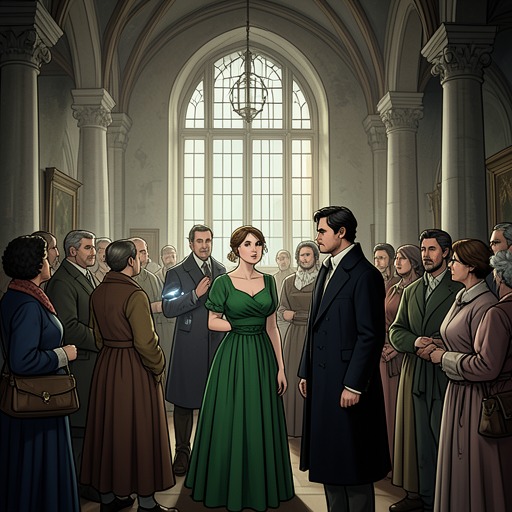
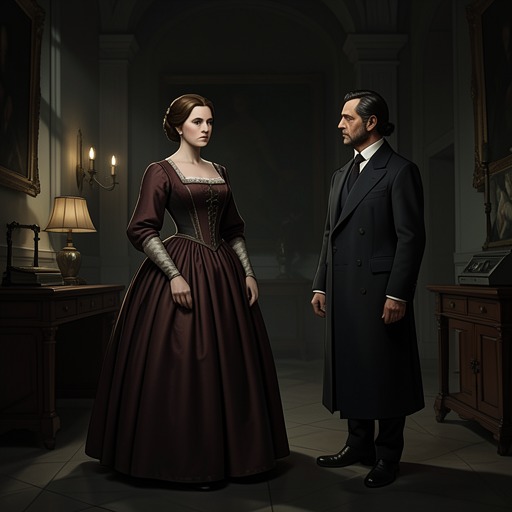
The Earl appears during the confrontation over Darcy’s courtship of Elizabeth Bennet. Lady Catherine de Bourgh arrives furious that Darcy is courting another woman, while Darcy refuses to accept that an alleged understanding with Anne binds him. The Earl reinforces Lady Catherine’s dynastic argument, but Darcy exposes the asymmetry in it: if the purpose is to unite the family, why are the Earl’s own unmarried sons, Andrew Fitzwilliam and Richard Fitzwilliam, not being offered as the means of achieving that union?
Darcy’s reply challenges the Earl’s assumption that the younger generation exists to serve the family’s advancement. The exchange also reveals a hierarchy within the hierarchy. The Earl can demand that Darcy obey family expectations and can rebuke Darcy for answering sharply, yet Darcy points out that his aunt and uncle are permitted to harangue him while he is denied the right to respond. The Earl’s authority therefore depends not only on rank but on etiquette: deference is expected to flow upward, even when the elders are attempting to control an adult man’s marriage.
When Darcy accuses Lady Catherine of exceeding her income and selling farmland, the Earl defends his sister and objects to Darcy’s manner of speaking to her. Darcy’s evidence turns the quarrel from a question of manners into a question of financial credibility. The Earl does not resolve the dispute; instead, Darcy warns that the matter remains in his hands and that no public breach has yet occurred. This preserves the possibility of family rupture while showing that the Earl’s authority is no longer sufficient to compel Darcy’s obedience.
Relation to the Novel’s Social Order
The Earl’s role is chiefly explanatory and oppositional. Through Elizabeth’s account of his title and parliamentary influence, the novel presents aristocratic society as a network in which family, property, law, and marriage reinforce one another. Through his attempt to sustain the Darcy-Anne de Bourgh match, that abstract system becomes personal pressure. The question is not simply whom Darcy loves, but whether a titled family may treat his marriage as a political resource.
His contrast with Sir David Pentland is equally revealing. Sir David’s wealth begins with naval service and the salvage of a Spanish treasure galleon, whereas the Earl’s authority is inherited and institutional. Sir David uses his resources to protect Elizabeth Bennet and plan for her escape from domestic coercion; the Earl appears within a system that seeks to preserve family rank through marital control. The contrast does not make the Earl an isolated villain so much as a representative of two competing uses of power: one directed toward personal autonomy and refuge, the other toward dynastic continuity.
Narrative Function and Limits
The Earl is a relatively limited, function-driven character rather than a fully elaborated independent protagonist. The evidence does not provide a sustained private biography, personal transformation, or decisive action outside family politics. His importance comes from what his title authorizes him to represent: the legislative reach of the peerage, the prestige of the Matlock family, and the expectation that aristocratic marriages should serve collective advancement.
That limited characterization is narratively effective. He helps translate the novel’s critique of social power into a family scene where abstract interests become audible as commands, interruptions, and appeals to duty. By opposing Darcy’s freedom without personally compelling the marriage, he also shows the limits of aristocratic control once an heir refuses to treat family strategy as a binding moral law. The Earl remains a figure of inherited authority, but the future he tries to preserve is weakened by the very question Darcy puts to him: why should one individual bear the burden of uniting a family when the family’s other men are not asked to sacrifice their own choices?